Column

Three Shelves Toward Japan

A design student builds English from grammar books, vocabulary, and immersion, aiming at study abroad rather than a language collection.
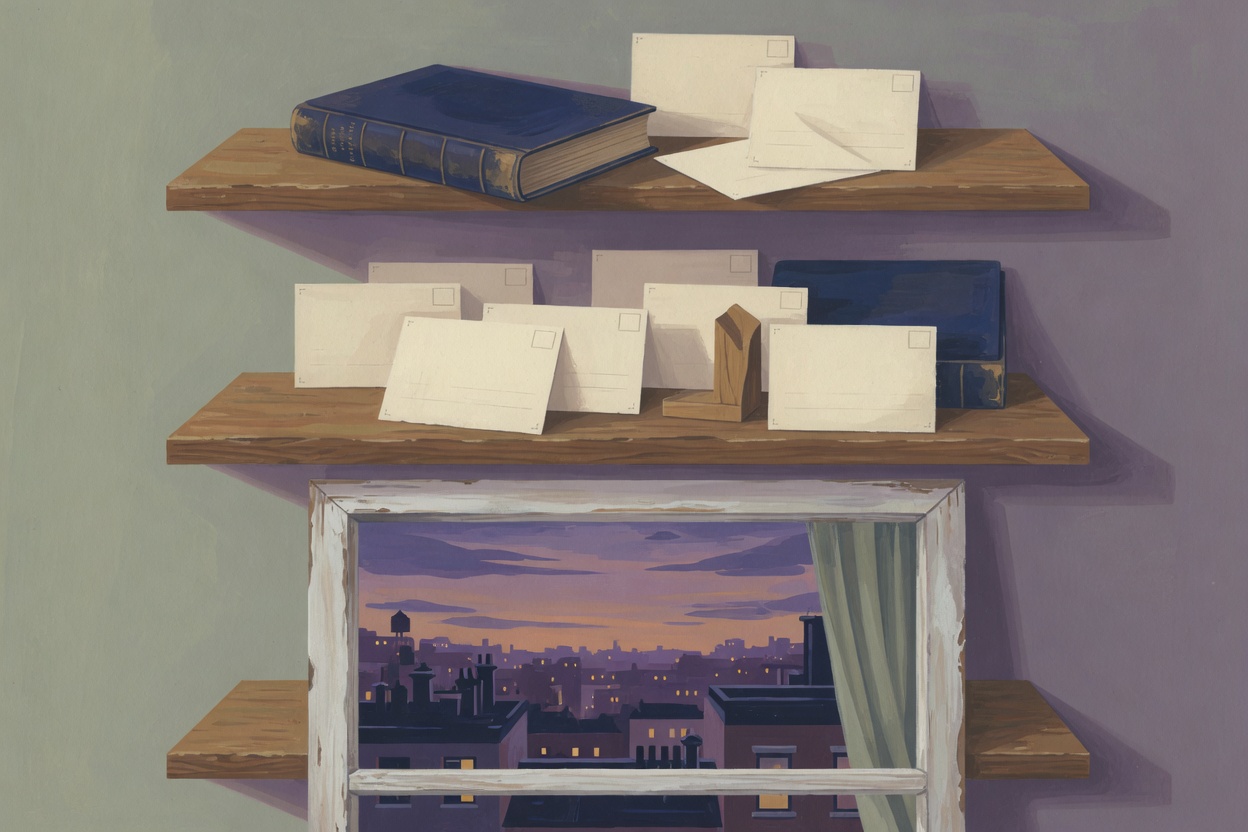
An editorial illustration of three wooden shelves holding a grammar book, loose cards, and a window open onto an unnamed city at dusk.

The channel is small. The About line is almost shy: a person who likes design, creativity, growth; a curious learner, happy to share discoveries. The keywords around the channel point toward a master’s in architecture, toward Japan, toward living abroad. The video that matters here has a title that would be easy to mock if it were empty: *How I Learned English from Zero to FLUENT*. Underneath, the writer is more modest than the capitals. She is talking about a path from knowing no English to being confident enough to study abroad. She tags it self-taught.

She does not, in the words that can be checked, name a university. She does not name a city street or a landlord. The public story is thinner than a memoir and thicker than a tip list. It has three shelves, and she labels them herself in the chapters: grammar books, building vocabulary, immersion. The order is the plot.

Grammar books come first. That is not fashionable. A certain kind of internet language story begins by throwing the book across the room. Her chapter does the opposite. Before she trusts herself in the wild, she sits with the sort of object that has tables in it, explanations, the slow work of seeing how a sentence is built. We do not know which titles. Inventing them would be a lie. What we know is that she thought the books deserved the first timestamp. For someone aiming at study abroad, that choice has a practical weather. Lectures, readings, emails to a department — they are not only vibe and Netflix. They have clauses. They have the kind of English that a grammar book, for all its dryness, still tries to show.

Then vocabulary. The second shelf is not a pretty word cloud. It is the unglamorous accumulation of words a person does not yet have when the first semester is still a rumor. She does not, in the description, say how she stored them. There is no verified deck, no verified notebook brand. There is only the admission that building a lexicon was its own phase, separate from the books and separate from what came after. A person can finish a grammar chapter and still stand in a supermarket without a word for the thing in her hand. The middle shelf is that standing.

Immersion is last, and the placement is the most honest thing in the video. She does not claim she swam first and learned to kick later. She put the water at the end of the chapter list, after the books and the words. Immersion, in a title like hers, is the part that makes study abroad imaginable: English not as an exercise but as the air in a room she has not yet entered. The description does not tell us whether that air was YouTube, lectures in English, friends, or the country itself. The indexed line that can be quoted without pretending we heard the whole tape is simpler. Most of it, she says in the fragment that search engines caught, was self-taught. She did not have expensive courses or tutors.

That sentence is doing a lot of work. It is not a flex. It is a budget. A design student pointing herself at Japan does not, in this telling, buy a glossy program. She uses the three shelves she can reach. The video description later includes an italki link with a referral. The report is strict about that link: she does not write “I used this.” The link sits there. It is not evidence of a tutor. The story that can be told is still the self-taught one.

There is a time shape even without a diary. Zero is a real starting word in her title and in her description. Fluent is the word she chose for the other end, and she ties it to a concrete use: confident enough to study abroad. Fluency here is not a polyglot’s party trick. It is the English you need to go. The architecture keywords, the Japan keywords, the living-abroad keywords sit around that sentence like furniture we are not allowed to rearrange into a floor plan we have not seen. We can say only that the person telling the story is the kind of learner who cares about design and who has aimed her life at study in Japan. The English was the door she had to cut herself.

Repetition is implied in the three shelves more than it is filmed. Grammar books are not read once. Vocabulary is not built on a Tuesday. Immersion, whatever form it took, is not a weekend. The video is eight minutes and forty-eight seconds. The life under it is longer. She compresses years into three labels because that is what a short video can honestly hold. A longer essay that invented the missing years would be smoother and false.

Hesitation lives in the gap between the shelves. A person who starts with grammar books is a person who does not yet trust the ear. A person who then stops to build vocabulary is a person who has discovered that rules do not supply words. A person who finally names immersion is a person who has discovered that words on a page do not yet behave in a conversation. Each chapter is a correction of the last. None of them, in her public telling, is declared a mistake. They are sequential. The hesitation is the pause before she admits the next thing is required.

The accidental breakthrough, if we stay inside what she wrote, is not a lightning phrase overheard on a train. It is the accumulation that made study abroad feel possible. She does not narrate the acceptance letter. She narrates the method that, in her account, got her from zero to the kind of English that could carry a degree in another country. The aftertaste is quiet. A small channel. A first-name initial. A set of chapters that refuse to be clever. Grammar, words, immersion. Then you go.

Later viewers will want a fourth shelf, a tool, a hack. She does not, in the verified text, give them one. She gives them the order she actually used, and she gives them the reason she needed the order: not to become a person who collects languages, but to become a person who could leave, study, and live in the work she already loved.

Story details

  • Series: *multi-lingual and their ways of learning*
  • Article date: 2026-08-16
  • Keywords: language learning; multilingual learning; polyglot; self-taught English; study abroad; grammar and immersion

Sources